Mercedes-Benz India runs on Qntrl: Lessons in digital transformation
Qntrl gives Mercedes Benz the perfect balance: powerful automation and integration that we can trust, with the visibility and governance that Mercedes-Benz requires
- Shraddha Ukalkar, CIO at Mercedes-Benz India
There's a reason luxury brands obsess over details others overlook.
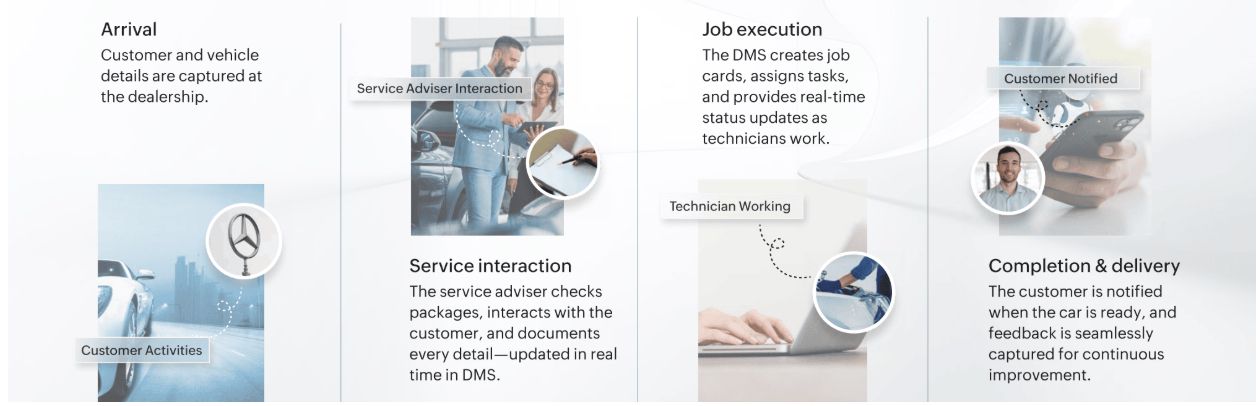
When a customer brings their Mercedes-Benz in for service, they expect precision. Not just in the repair, but in every interaction. The appointment confirmation. The status update. The pickup notification. Each touchpoint reflects whether the brand truly delivers on its promise.
Now imagine coordinating that experience across 27 dealerships, each running independent operations, all connected to legacy enterprise systems that were built before smartphones existed.
That was the reality for Mercedes-Benz India. And their solution offers a glimpse into why the technology decisions you don't see often matter more than the ones you do.
What breaks when systems can't talk to each other
Most enterprise technology projects start with the visible layers: the CRM interface dealers will use, the mobile app customers will see, the dashboards executives will review.
Integration gets discussed in implementation meetings. It's treated as a technical checkbox, something the IT team handles after the "real" decisions are made.
This approach has a predictable failure mode.
Mercedes-Benz India's landscape before transformation looked familiar to any enterprise IT leader:
Systems that couldn't speak the same language
Their European headquarters ran SAP, communicating through SOAP protocols designed in an era when XML was cutting-edge. Their new dealer management platform spoke REST - the modern standard, but incompatible without translation.
Data trapped in outdated formats
Critical information lived in flat files: CSVs, fixed-width exports, proprietary formats accumulated over decades. Each required manual handling before it could flow into modern systems.
Updates that arrived too late to matter
When a dealer updated an order status, that change had to traverse multiple systems before reaching SAP for logistics and invoicing. Delays meant customers received outdated information. Errors meant reconciliation headaches.
Blind spots everywhere
No single view showed what was actually happening across the network. Decision-makers relied on reports that were already stale by the time they arrived.
Why "connected" isn't the same as "orchestrated"
When Mercedes-Benz India partnered with Zoho to build their new dealer management system, SKYLine, they made an unconventional choice: treating orchestration as a foundational platform decision rather than an implementation detail.
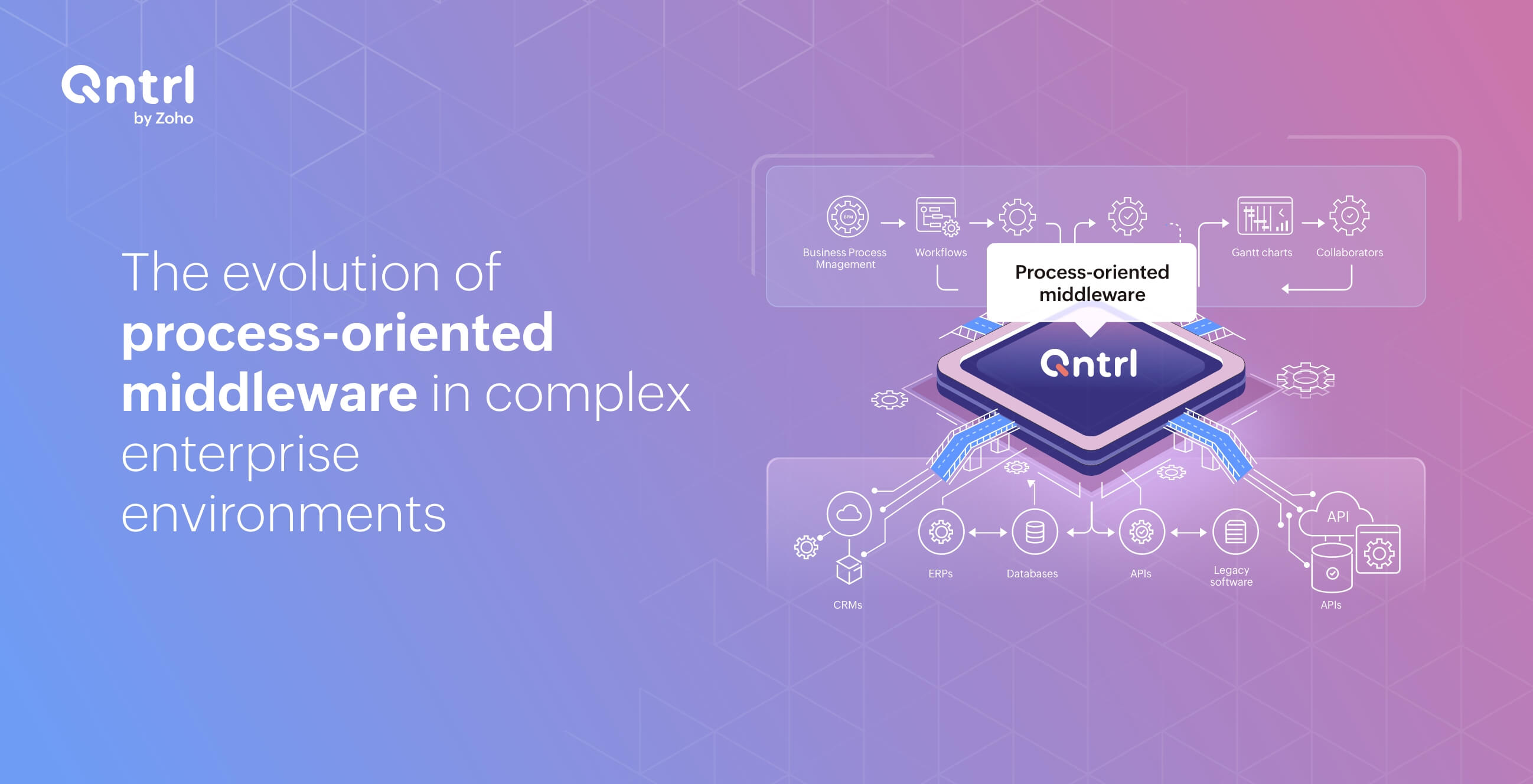
Qntrl became the intelligent middleware layer, not just connecting systems, but governing how data and processes flow between them.
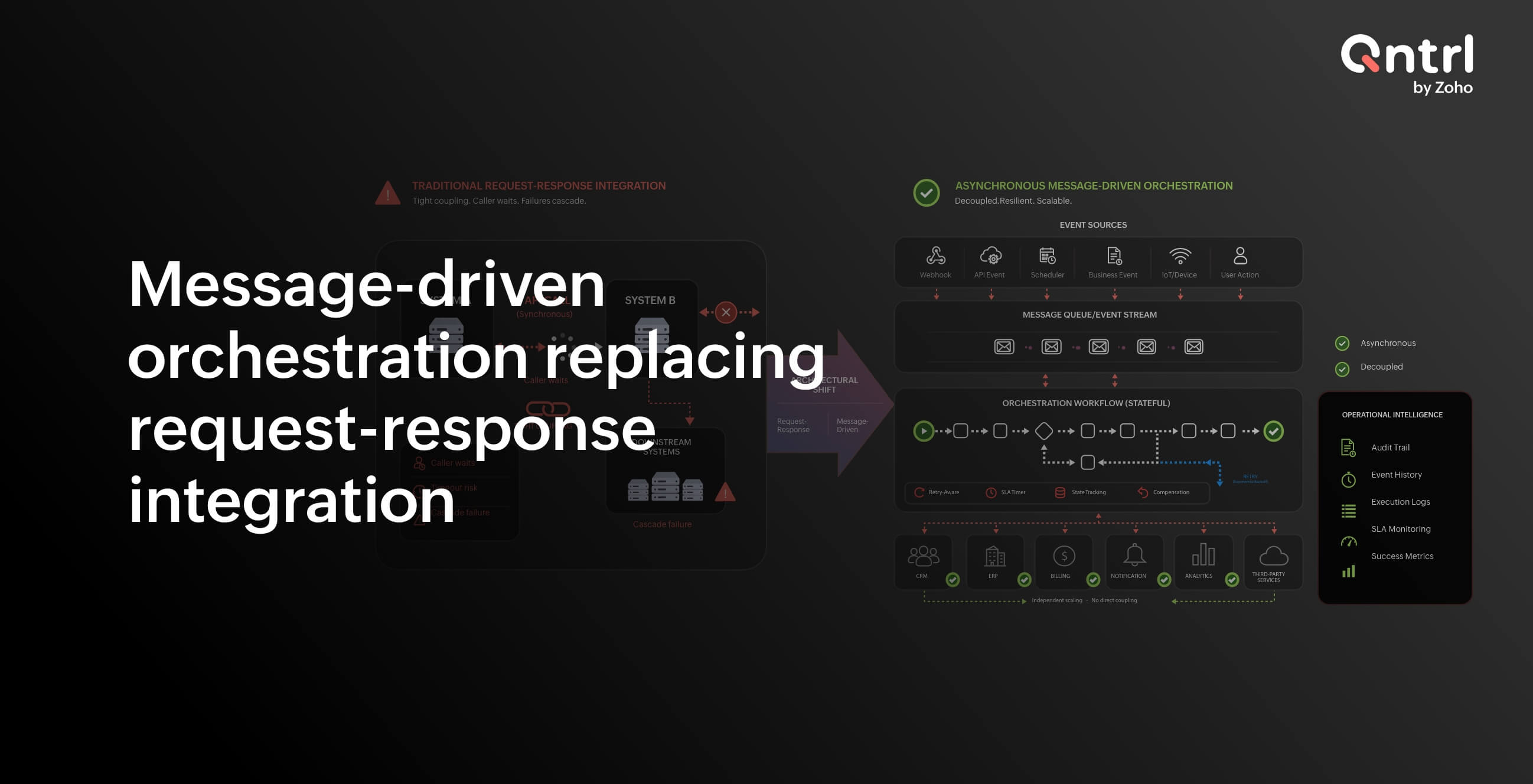
The distinction matters. Traditional integration tools move data from point A to point B. Orchestration platforms do something fundamentally different:
Translation instead of simple transfer
Qntrl handles bidirectional protocol conversion in real time. When SAP sends SOAP-formatted requests, Qntrl translates them into REST calls that SKYLine understands. When dealers update records in the CRM, those changes flow back to SAP in the format it expects - automatically, accurately, and instantly.
Transformation without constant oversight
Qntrl fetches the legacy flat files on schedule, parses the data, validates it against business rules, maps fields to their destinations, and commits clean records, all without human intervention. What once required manual effort now happens invisibly.
Governance at the core
Every process follows defined rules. SLA timers trigger escalations. Exceptions route to the right teams. Audit trails capture every transaction. The orchestration layer becomes the single source of truth for process state across the entire ecosystem.
Autonomy with governance: Solving the scale paradox
Here's where Mercedes-Benz India's requirements got genuinely difficult.
They didn't just need integration. They needed federated integration, a network where each dealership maintains autonomy over local operations while participating in a unified, governed ecosystem.
Most enterprise platforms assume centralized deployment. This means one database, one instance, one source of truth.
Mercedes-Benz needed the opposite
Close to 30 independent instances, each with its own data, its own configurations, its own operational reality, yet seamlessly connected to headquarters systems and each other.
Qntrl's architecture made this possible by orchestrating at the network level:
Instance provisioning without custom integration
When Mercedes-Benz adds a new dealership, they provision an instance and connect it to the orchestration layer. Master data synchronizes automatically, no bespoke integration project required.
Local control with central visibility
Each dealer operates independently while Qntrl ensures that every transaction, status update, and exception is visible to OEM stakeholders who need it.
Consistent governance without rigid uniformity
Business rules enforce compliance and quality standards. But within those guardrails, dealers have flexibility to operate according to local realities.
The result is a federated ecosystem that scales by design, not by heroic engineering effort.
What this means for your next IT decision
Mercedes-Benz India's experience generalizes beyond automotive, dealer networks, and any specific industry vertical.
Basic questions every enterprise leader should ask:
1. Are you treating integration as a platform category or an implementation detail?
If orchestration only comes up after you've selected your core applications, you're likely underinvesting. The middleware layer often determines whether those applications deliver their promised value.
2. Do you need translation or just transportation?
Point-to-point integrations work when systems speak the same protocols and data formats. They break when you're bridging legacy and modern worlds. Intelligent orchestration handles the translation that makes heterogeneous environments work.
3. Can your architecture support distributed operations?
Centralized systems are simpler to build but harder to scale across autonomous business units. If your organization operates through franchises, dealerships, regional offices, or partner networks, you need orchestration that works at the network level.
4. Where does governance actually live?
Compliance, audit trails, SLA enforcement, exception handling...these capabilities can't be afterthoughts. If your integration approach doesn't include governed workflows, you're building visibility gaps into your architecture.
For enterprises that can't afford to compromise
Your customers may not drive luxury vehicles. But they expect the same thing Mercedes-Benz customers expect: that every interaction with your organization reflects precision, reliability, and attention to detail.
That experience depends on systems working together seamlessly, even when those systems were never designed to work together.
The applications you choose matter. The orchestration layer that connects them determines whether those choices compound into competitive advantage or fragment into operational friction.
Most enterprises figure this out the hard way: after a failed go-live, a compliance gap, or a customer experience disaster that traces back to systems that couldn't talk to each other. Mercedes-Benz figured it out beforehand with Qntrl!
Qntrl is an enterprise IT orchestration platform from Zoho Corporation.
Learn more at qntrl.com.

Enjoying your reading?
Enjoy organization and visibility too!
Qntrl can help you organise, control and improve production and projects in your team.