Qntrl's 2025 year in review: Middleware, IT orchestration, and product highlights

This year, we strived to evolve Qntrl from a core BPM platform into a broader orchestration and middleware solution that helps teams connect people, processes, and systems, and it worked. Our focus has been practical: to make integrations more reliable, provide process owners with clearer controls, and enable engineering teams to automate safely and securely.
Deeper integration: Web services, files, and database tasks
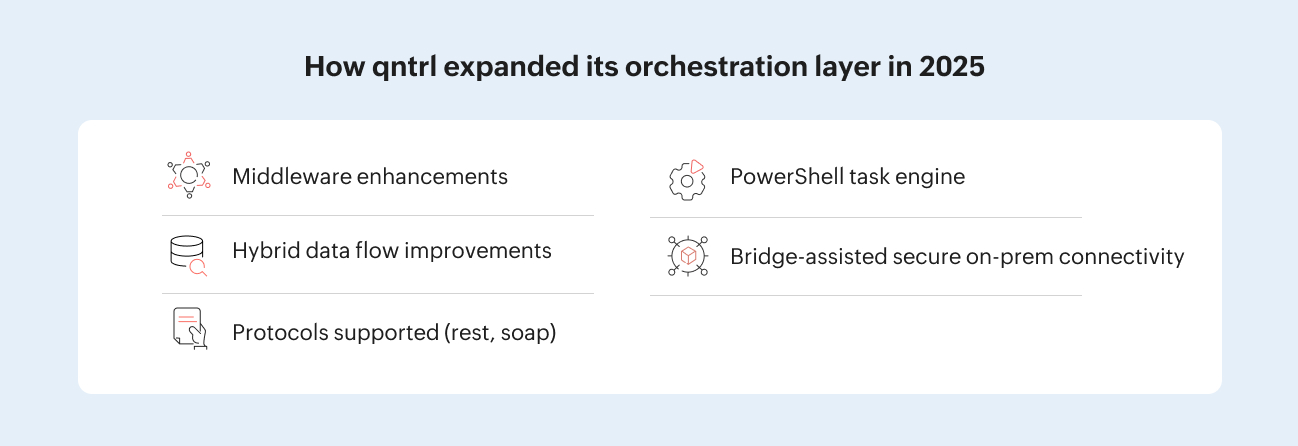
We spent 2025 continuously strengthening Qntrl’s ability to communicate with other systems. We follow the details how Qntrl handles inbound and outbound API communication, allowing workflows to receive and send data via standard protocols, with gateway checks and preprocessing before a workflow runs.
The Files API (v3) provides programmatic control over file operations, which is useful when workflows need to reliably move or reference documents. For data-centric jobs, DB tasks let Qntrl run queries and interact with databases as part of an automated circuit. Together, these capabilities reduce the need for brittle scripts and point-to-point hacks by providing governed, repeatable integration building blocks.
Qntrl’s PowerShell task engine enables circuits to run PowerShell scripts and everyday Windows operations on machines within a private network via the bridge agent. It supports six states: PowerShell engine (running a script), installing a Windows app, uninstalling a Windows app, starting a service, stopping a service, and restarting a Windows server.
These actions require an active bridge installation, along with the appropriate credentials. You can supply script IDs, hostnames, variables, and credential mappings in the builder or code view, which makes tasks like remote software installation, service control, or OS provisioning part of an automated circuit rather than a manual operation.
Circuits, versions, dashboards, and functions: Orchestration that’s easier to manage
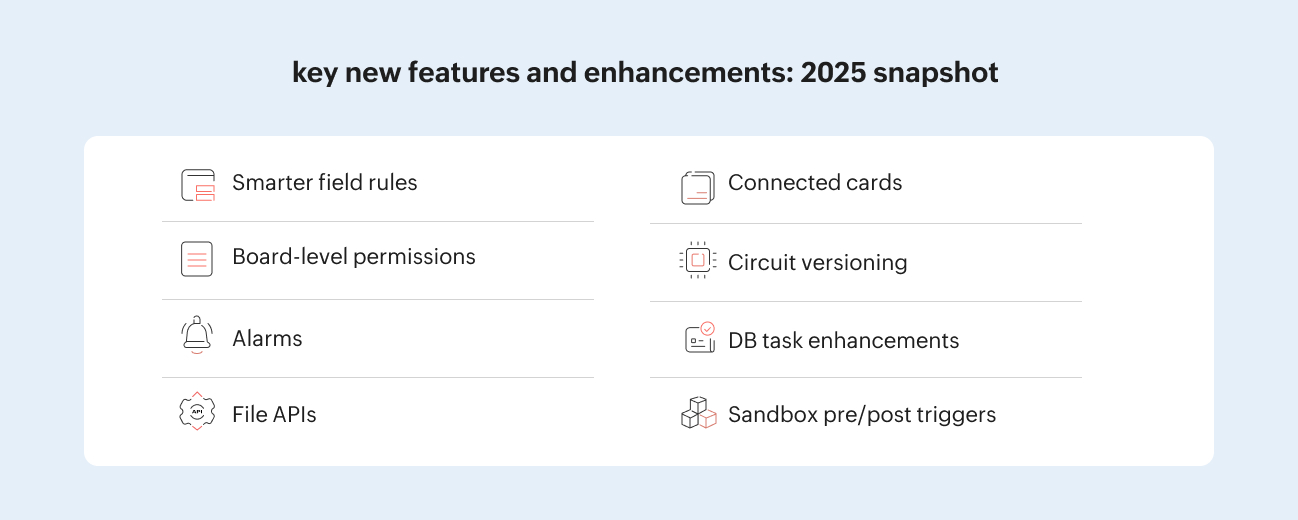
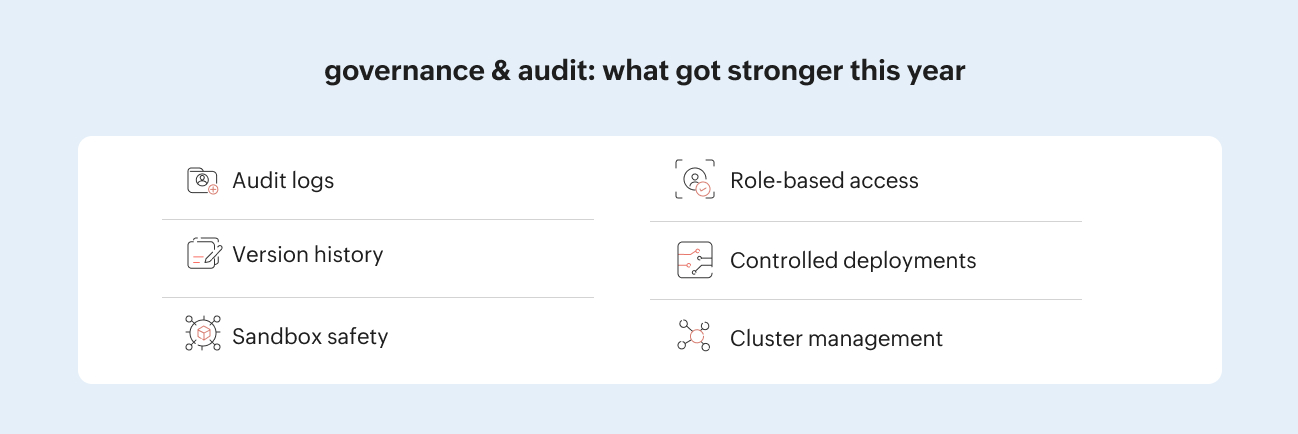
Circuits remain the heart of Qntrl’s IT orchestration. This year, we reinforced the platform’s operational tooling: Circuits now display version controls, allowing teams to manage changes safely, and dashboard actions make it easier to surface operational metrics and health within a circuit. Functions enable teams to encapsulate reusable logic within the orchestration flow, providing a practical way to keep complex steps modular and auditable. These additions make it simpler to understand system-to-system flows and roll out changes with confidence.
Safer change management with sandbox automation and pre/post triggers
We also expanded our sandbox capabilities, allowing teams to test automations before they reach production. Sandbox automation supports pre- and post-deployment triggers, allowing controlled validation and automated tasks around deployments. The advanced sandbox capabilities illuminates how teams can stage changes, run test scenarios, and avoid surprises when releasing new workflows or integrations. This investment helps mitigate risk when updating processes that interact with multiple systems.
Better governance and access control
Governance and role separation are central to scaling process automation. The profiles and board-level permissions clarify how teams can set permissions at the board level, providing leaders with more granular control over who can perform what tasks within a board. This makes it easier to keep sensitive processes governed while still enabling teams to operate independently.
Smarter rules and conditional logic
Field rules are now more expressive. The new criteria conditions let you check whether a field is “empty” or “not empty,” which simplifies building conditional routes and validation checks in a blueprint. Small changes like this reduce manual handling and make forms and blueprints behave more predictably.
Connected cards and richer workflow models
Cards are the primary unit of work inside Qntrl boards, and this year, we clarified the behavior of connected and standalone cards. Enabling users to create connected cards helps teams model linked processes: For example, a parent request spawning child tasks across teams, without losing traceability. This is a practical step toward representing complex business processes without custom engineering.
Monitoring, alerts, and operational continuity
Alarms provide a way to monitor and respond to operational conditions. The alarm feature helps teams create automated notifications or actions when specific conditions are met, improving responsiveness. And on the infrastructure side, Qntrl can be deployed with clustering considerations, which supports higher availability and operational resilience for mission-critical deployments.
Files, DB tasks, and developer-facing docs
We also invested in the developer side of our platform. The API reference and DB task assets provide the playgroundfor integrating storage and database operations into circuits and blueprints. While these aren't flashy features, they are the building blocks that let engineering teams replace fragile scripts with governed automation.
What this all means for teams
Taken together, these 2025 updates make Qntrl more than just a platform for modeling human workflows. It now provides the pieces enterprises need to do reliable system-to-system orchestration, manage change safely, and keep operations auditable:
- Integrations become governed and repeatable rather than ad hoc.
- Deployments and changes can be tested in a sandbox with pre/post triggers.
- Process owners get more precise controls through board-level permissions and smarter field rules.
- Engineers gain access to useful primitives, functions, database tasks, file APIs, and circuit versions to build resilient automations.
While implementing all of these improvements, we’ve intentionally focused on practical, composable capabilities that reduce operational risk and speed teams up without sacrificing governance.
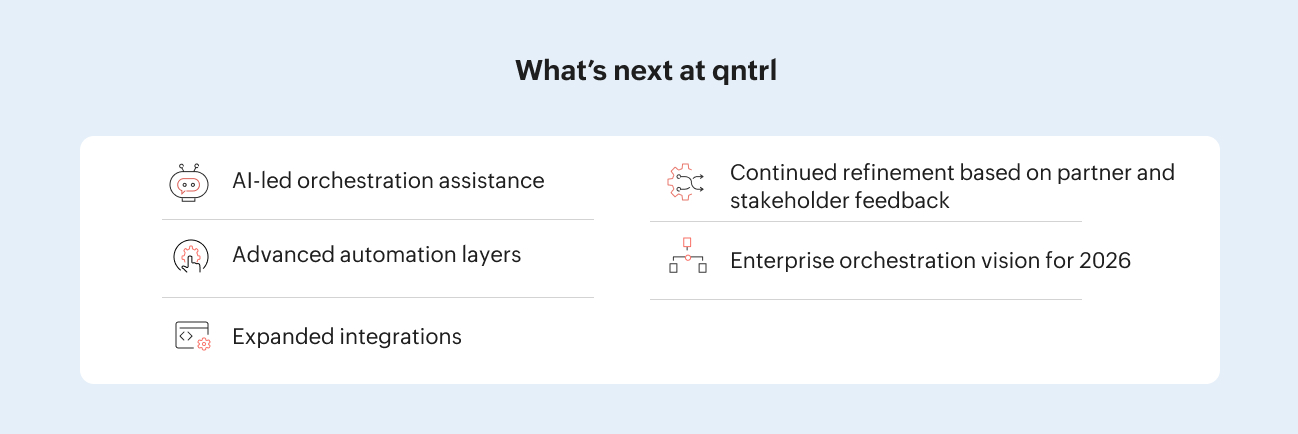
Looking ahead, we’ll continue building on these foundations. We’re exploring ways to bring more advanced AI capabilities into orchestration, making decisioning and remediation smarter within circuits, and extending higher-level IT orchestration that spans a broader part of the enterprise running stack. We’re also listening to feedback from Partners, customers, and the community, and folding those inputs into product decisions.
In the coming year, we’ll continue shipping careful, verifiable improvements that enable teams to automate with confidence, while keeping control and observability front and center.
Here's a more in-depth look at all the new features and enhancements for 2025.

Enjoying your reading?
Enjoy organization and visibility too!
Qntrl can help you organise, control and improve production and projects in your team.